
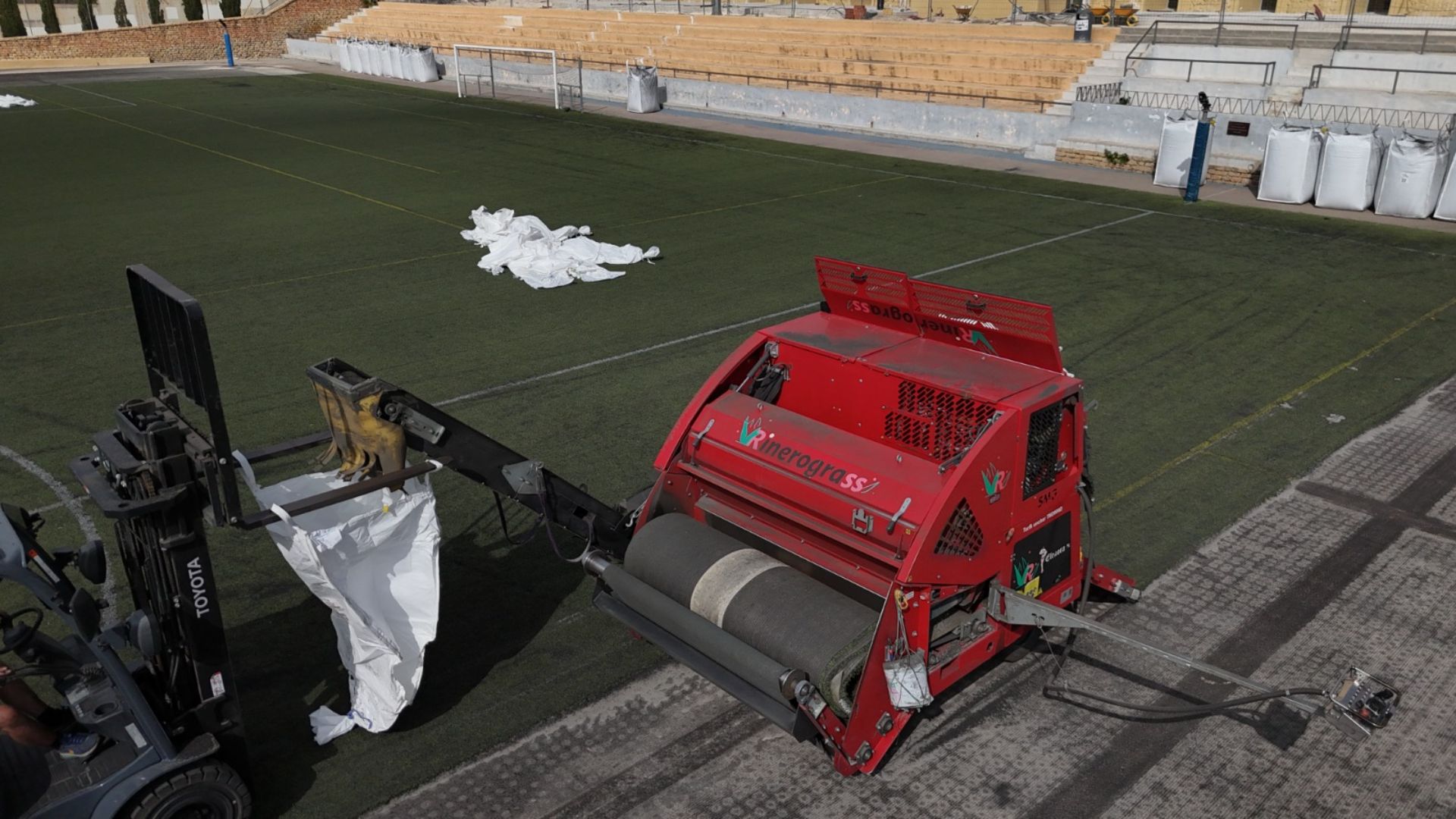
The Valencian manufacturer directs the development and validation of sports seats produced from recycled artificial grass, in a circular economy initiative co-financed by the European Union through the FEDER Comunitat Valenciana 2021-2027 program
At FanBase we have been manufacturing seats for sports facilities for more than 40 years. And one thing has been clear to us for a long time: the future of sports equipment is not just about durability or compliance with UEFA/FIFA regulations, but also about the circularity of materials. That is why we participate, leading one of its key pieces, in DECAMP, an R&D&I project that is converting a difficult-to-treat waste, artificial grass at the end of its useful life, into new products with high added value.
What is DECAMP
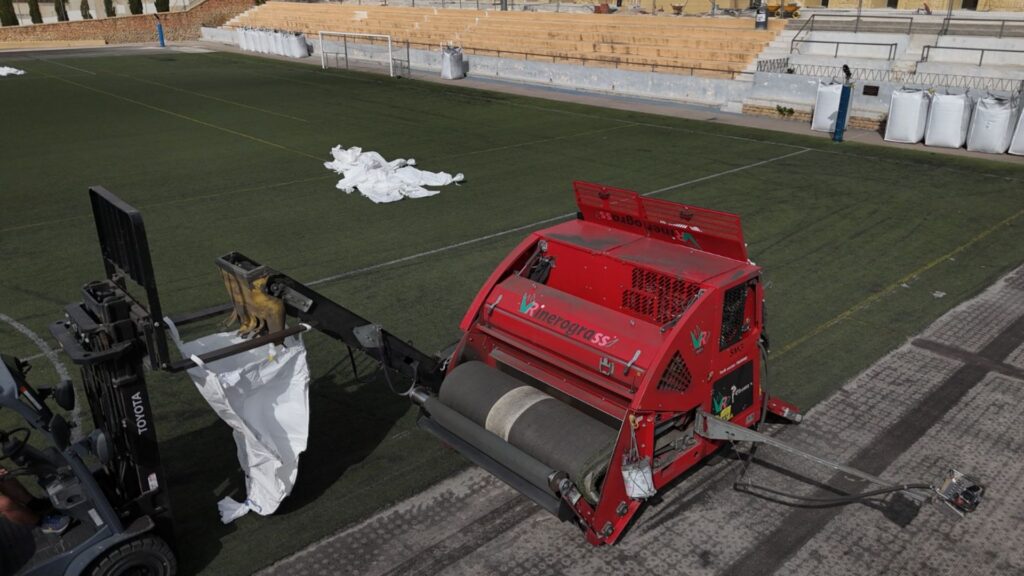
DECAMP is a comprehensive artificial grass recycling project co-financed by the Department of Industry, Tourism, Innovation and Commerce of the Generalitat Valenciana through Ivace+i Innovació, with the economic support of the European Union through the FEDER Comunitat Valenciana program for the period 2021-2027.
The objective is as ambitious as it is necessary: recover and treat all fractions of the uninstalled grass—from fibers to latex bases—to manufacture new products instead of sending the material to landfill. Today, much of this waste ends up in waste dumps or is subjected to very limited recycling processes. DECAMP proposes a real alternative: that the removed grass be transformed into sports furniture, elastic bases for new synthetic fields and material for 3D printing.
Unlike other initiatives on the market, DECAMP does not limit itself to recovering materials: it addresses their complete transformation into useful products within the field of sport itself. It is truly circular economy, from start to finish.
FanBase’s role: the seat, in the center
Within the consortium, FanBase leads the design and validation of sports seats made with these new recycled materials. It is not a secondary role: the seat is precisely the product that closes the circle, which demonstrates that a material recovered from an artificial grass field can return to the stands converted into a seat that meets the technical demands of the sector.
It is a work that connects directly with our industrial experience in injection of polypropylene copolymer and with our obsession to validate each material before taking it to production. The new recovered compounds—mainly polypropylene (PP), polyethylene (PE) and latex—are being characterized and tested at different scales, from laboratory to pilot and industrial environments.
A consortium that adds knowledge
DECAMP is coordinated by Acteco Productos y Servicios, which is in charge of the mechanical and physical recycling stages of the recovered material. Together with FanBase they participate:
- Realturf Systems, which contributes its experience in the design and structure of artificial grass and supplies the material used for testing.
- ADDITIUM, specialized in 3D printing technologies, which develops new applications from recycled materials.
The project is also supported by two reference technology centers: Aimplas, the institute of the plastics sector, which contributes its knowledge in material characterization, physical recycling, formulations and pilot scaling; and the Instituto de Biomecánica de València (IBV), which leads the functional validation of the new products and carries out the impact absorption, resistance and deformation tests.
Getting ahead of Brussels
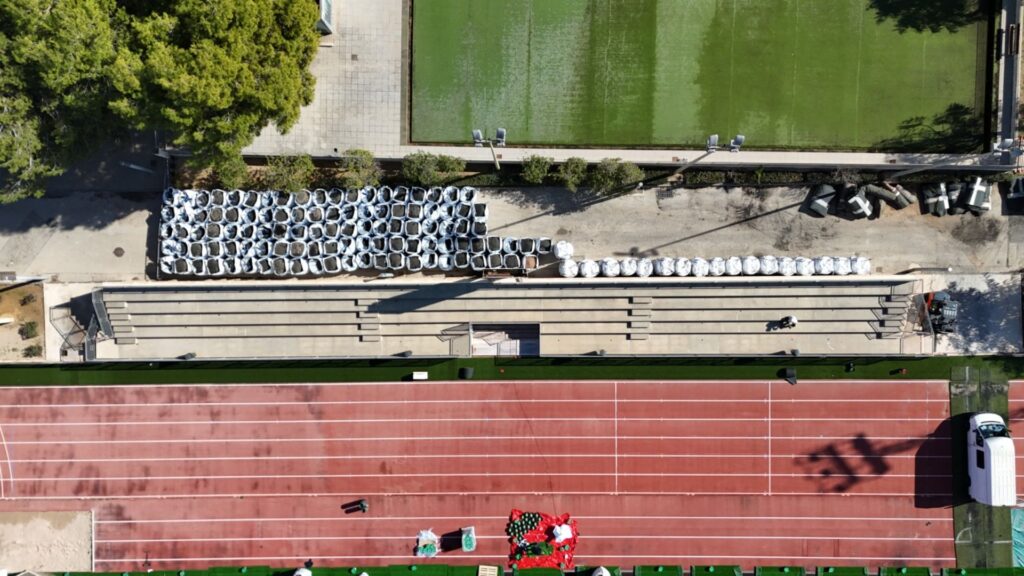
DECAMP does not respond only to an environmental conviction: it also anticipates the regulatory changes that Brussels is preparing, including the future ban on rubber infill in synthetic fields. For clubs, city councils and federations, this means that equipment decisions made today will have to look far beyond the purchase price: sustainability and traceability of materials are already decisive ESG criteria in European public specifications.
Objectives already met
After the first two years of development, DECAMP is in an advanced phase and has already completed its main objectives. The different fractions of the material have been crushed, separated and characterized with purity levels suitable for reuse, and the first pilot batches of high-quality recycled plastics have been produced. From them, the project is already developing applications such as elastic base plates and latex mixtures intended for 3D printing.
Why this matters (and why it fits with FanBase)
DECAMP is the second great test of the same principle that runs through our entire way of understanding this business: sustainability is only valid if it is verifiable. We already demonstrated it with Real Betis, installing seats produced from fishing nets recovered from the sea. Now we are taking a step further, working so that the grass of a sports field itself can be reborn as the seat of a stand.
For architects and engineers who prescribe equipment, for clubs that want a solid sustainability story for their fans and sponsors, and for administrations that must meet increasingly demanding ESG criteria, this translates into something concrete: a manufacturer that does not improvise in circularity, but rather investigates it, validates it and takes it to production.
Are you working on a stand installation or renovation project and is the sustainability of the materials a priority? At FanBase we can accompany you from the technical specification. Write to us at marketing@fanbase.es.