
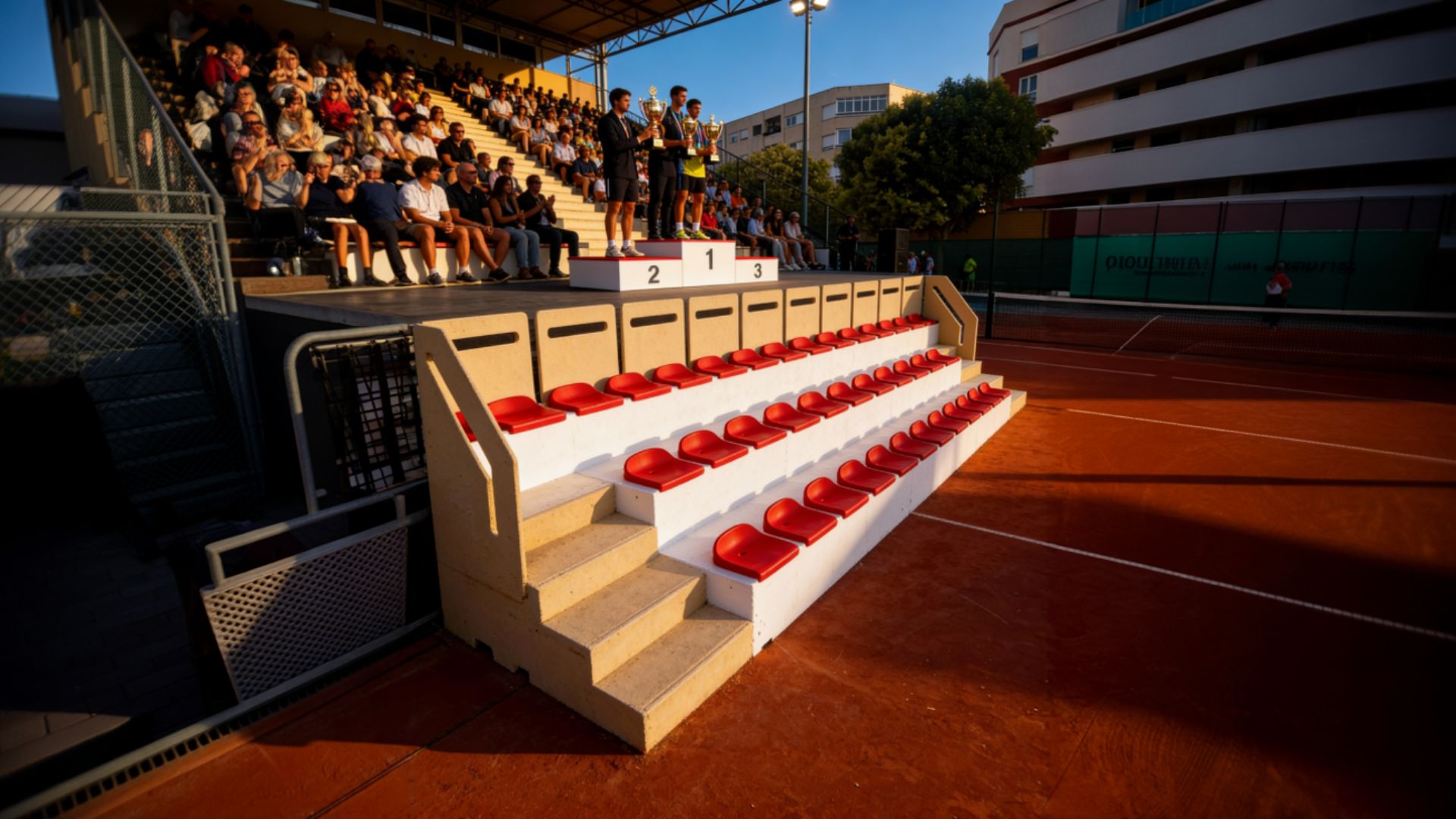
There is a moment that is repeated in almost all sporting events: the big day arrives and the “normal” capacity does not work. The public remains standing, areas that were not intended for spectators are improvised and the experience suffers just when you have the most at stake: tournament, inauguration, key match, fan zone or brand activation.
And the dilemma appears: How do you add seats without getting into work, without impossible deadlines and without buying one? fixed stand “just in case”?
The self-supporting and portable modular stands EcoBench are designed to solve it with a simple idea: convert the capacity into something scalable and reversible. You put capacity when you need it. You remove it (or move it) when it stops making sense.
When the The calendar rules, “without work” stops being an option and becomes a necessity
In the real world, the work arrives late. Or it comes with a complexity (licensing, deadlines, coordination) that only pays off if you are 100% sure that you are going to fill that stand for years.
EcoBench fits especially well when:
- You organize recurring events (tournaments, leagues, campuses) with peak audiences
- Your venue is multipurpose (today sport, tomorrow event)
- The club is in a growth phase and wants to expand capacity in stages
- You need a solution for this year / this season, not for “someday”
Self-supporting and modular: what you are really buying is operational control
A self-supporting and modular grandstand changes the conversation with operations and with events. You are no longer buying “a product”: you are buying ability to manage the public with order and flexibility.
With EcoBench you can:
- Sectorize (families, youth, guests, sponsors)
- Adapt to the real plan (not the ideal)
- Expand or reduce depending on the type of event
- Consider it in phases: Phase 1 now, Phase 2 when the demand is repeated
It is the difference between “I gamble with a fixed investment” and “I grow with data.”
“But… if it is made of plastic, can it hold up?”
This doubt is normal, because “plastic” is associated with a product of consumption. But in sports facilities we are not talking about generic plastic: we are talking about technical plastic, formulated for outdoors and intensive use.
To respond with solid arguments, focus on 4 ideas:
1) It is not “plastic”: it is stabilized technical material for outdoors
Durability in events does not depend on “whether it is plastic or metal”. It depends on what material it is, how it is formulated and whether it is prepared for sun and continuous use. copolymer) with anti-UV stabilization to avoid degradation due to exposure.
2) Exterior is not just blows: it is UV + aging + maintenance
In an event, “endure” too means:
- That the material does not degrade in the sun
- That it is easy to clean after intensive use
- That it manages spills/water without becoming a problem
Therefore, in solutions aimed at severe public use, the minimal maintenance approach is key: surfaces designed for quick cleaning and drainage details when applicable.
3) Resistance is demonstrated with tests, not with opinions
If a client asks you “does it last?”, the professional answer is: what tests/criteria support it?
In the world of sports equipment, resistance tests (impact, bending, etc.) and normative references are used. when there is an audience.
The objective is simple: that the product is designed for cycles (assembly, disassembly, storage and reassembly), not for “a pretty photo.”
4) The real guarantee is in the industrial process
One thing is to buy a generic solution and another is to work with a manufacturer that controls the process (injection, quality, repeatability) and has a product culture for sports facilities.
In EcoBench, the argument is not “it’s plastic and that’s it.” It is: technical material + design for public use + maintenance logic + industrial manufacturing oriented to durability.
If you want a unique phrase for sales:
“It is not consumer plastic: it is technical plastic for outdoors and intensive use, designed for repeat events.”
How to increase capacity without betting blindly: the phased approach
The typical mistake is to buy capacity “out of fear”: you oversize it, you use it little and it becomes a non-existent asset. The smart alternative is:
- Actual base capacity: the one you need most days
- Scenarios peak: 2–3 moments where you are overwhelmed (tournament, derby, campus, activation)
- Necessary extra: how many places do you need really for the event to work
- EcoBench as Phase 1: you cover that extra and test it in real operation
- Scaling: you only expand if demand is repeated
Thus, capacity stops being a bet and becomes a system.
Where EcoBench usually wins (and by what)
Event companies and traveling circuits
You need something that adapts to the layout of each venue. Modularity allows you to adjust orientation, sectors and size without starting from scratch.
Growing clubs (grassroots soccer, semi-pro, rugby, athletics, outdoor basketball)
The capacity accompanies the club. If you change facilities or grow in stages, you do not leave an investment “tied” to a site.
Padel clubs (tournament mode)
In paddle tennis, the square meter rules. The temporary stand gives a “pro” image in tournaments without sacrificing space on the rest of the days.
Town halls (specific events without work)
Closed calendar, short deadlines and need to justify investment. Modularity allows events to be covered without converting it into oversized fixed infrastructure.
Multi-use venues (fan zones, temporary extensions)
Today sport, tomorrow another event. Flexible infrastructure stops being an extra and becomes a tool.
Here are some questions that our clients usually ask us
Is EcoBench suitable for specific events and also for recurring use?
Yes. The key is to size it in phases: Phase 1 to cover the real peak and scale only if it is repeated.
Does “No work” mean that there is no need to plan?
The other way around: planning is what makes “no work” work well. Location, flows, access, operations and storage.
How do I respond to “if it is plastic, it won’t hold up”?
Explaining that it is not consumer plastic, but rather a technical material for outdoors and intensive use, and grounding it in what matters: use, maintenance and operational cycles. Resistance is demonstrated with technical criteria, not with opinions.
How do I avoid buying too much capacity?
With the phased approach: you cover the actual extra of 2–3 events and stops with data.